


How Dr. Ko-Cheng Fang’s X-Photon Technology Could Shape the Future of AI Chips, Optical Computing, and Next-Generation Electronics
Artificial intelligence is rapidly increasing the demand for faster, more powerful, and energy-efficient computing technologies. While today’s processors rely on electrical signals traveling through copper wiring, researchers worldwide are exploring photonic computing—a technology that uses light instead of electricity to process and transmit data.
Among the innovators working in this field is Dr. Ko-Cheng Fang, Founder, Chairman, and CEO of LongServing Technology Co., Ltd., a Taiwan-based technology company focused on developing X-Photon materials, photonic chips, AI processors, and optical communication technologies.
Through a series of newly released architectural designs and laboratory demonstrations, Dr. Fang has shared his vision of how photonic technology could influence the next generation of computing.
Introducing LongServing Technology’s X-Photon Material
One of the company’s most notable innovations is its proprietary X-Photon material, which has been developed to guide light through microscopic optical channels.
Unlike traditional electronic circuits that transmit information through copper wiring, LongServing Technology says its material enables light to travel directly through specially designed optical pathways.
To demonstrate the concept, the company conducted an X-Photon Optical Channel Test using a 1×1 cm ceramic-based chip, roughly the size of a fingernail.
During the experiment, laser light entered the chip from the bottom and successfully completed a 90-degree turn before appearing on the chip surface as a visible red line.
According to LongServing Technology, the demonstration shows that X-Photon material can function as an optical transmission channel similar to how electrons travel through copper conductors.
Because light travels significantly faster than electrons, the company believes the technology could eventually provide substantially faster data transmission while reducing power consumption and minimizing heat generation.
A New Generation of Photonic Chip Design
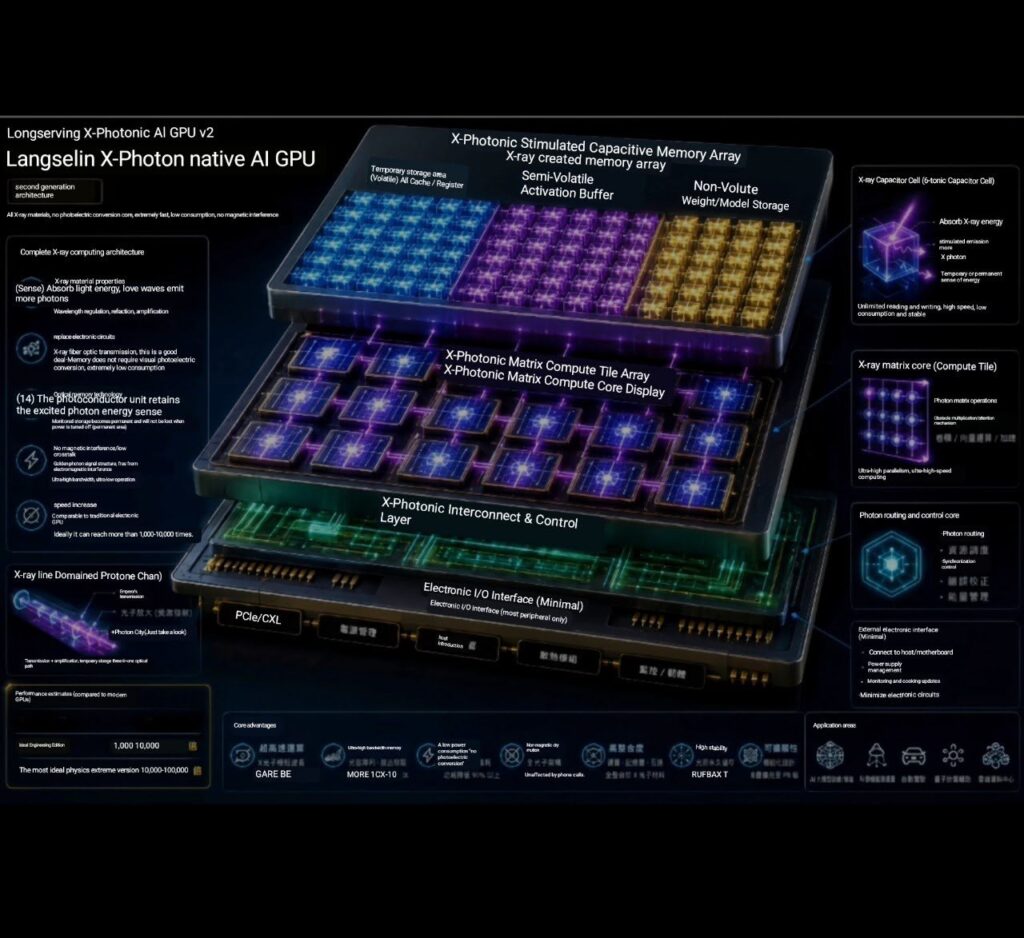
LongServing Technology’s conceptual 3D X-Photon AI GPU architecture designed by Dr. Ko-Cheng Fang, illustrating the company’s proposed three-layer photonic computing system integrating photonic memory, logic, and optical pathways.
On April 23, 2026, Dr. Ko-Cheng Fang officially unveiled several key components of LongServing Technology’s photonic computing platform for the first time.
The release included:
- A complete 3D photonic chip architecture
- A photonic pathway design
- A full-adder photonic chip structural demonstration
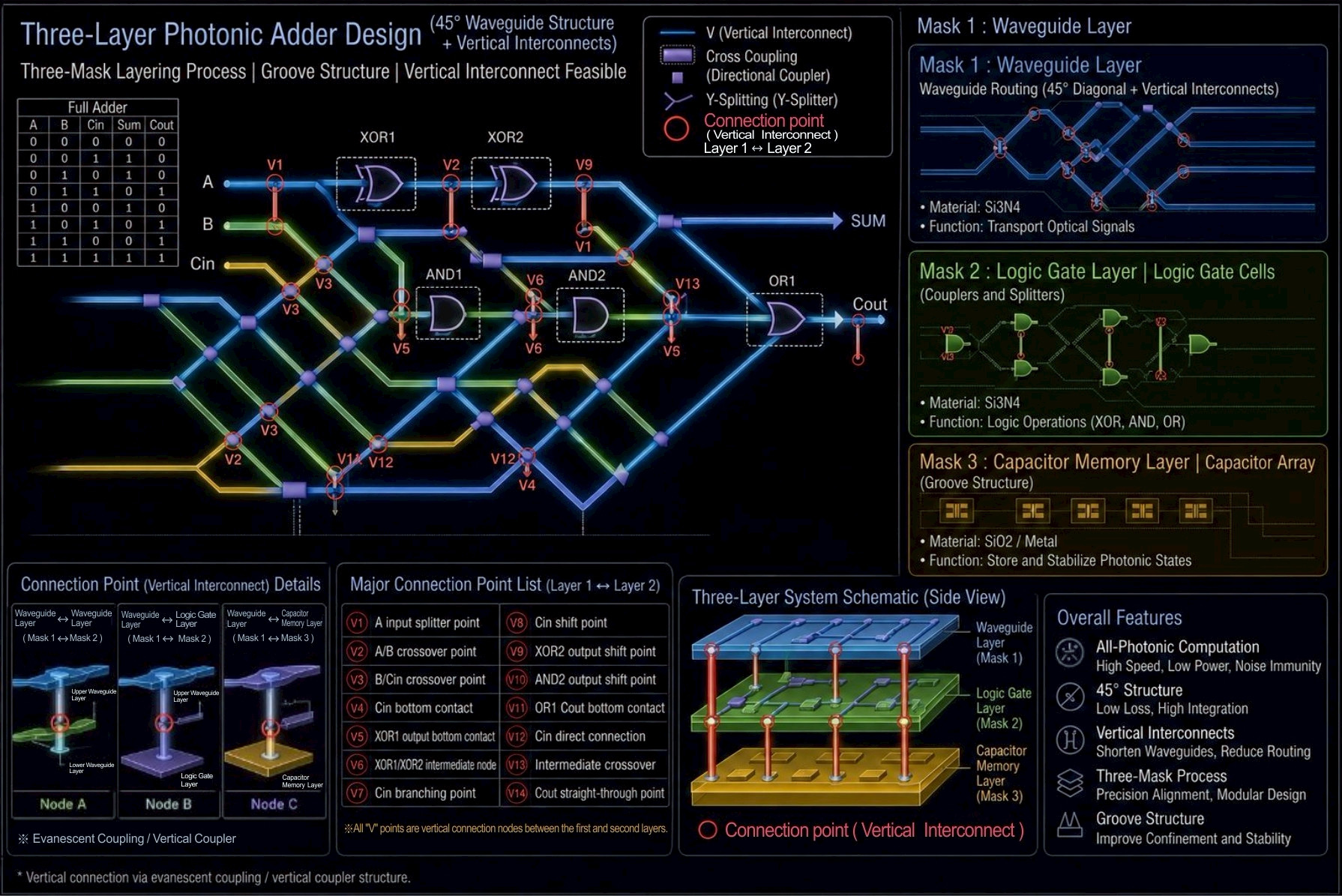
Full-Adder Photonic Chip Structural Demonstration designed by Dr. Ko-Cheng Fang, illustrating the proposed 45-degree optical pathway configuration, photonic logic gates, optical waveguides, and the three-layer architecture integrating photonic pathways, logic gates, and photonic memory.
According to the company, all architectural diagrams were personally designed by Dr. Fang, who is also the inventor of the photonic chip concept presented by LongServing Technology.
One of the biggest changes introduced is a 45-degree optical pathway configuration, replacing traditional electronic circuit layouts with a design specifically optimized for photonic signal transmission.
Three-Layer Architecture Simplifies Chip Design
The newly introduced photonic chip uses a three-layer architecture consisting of:
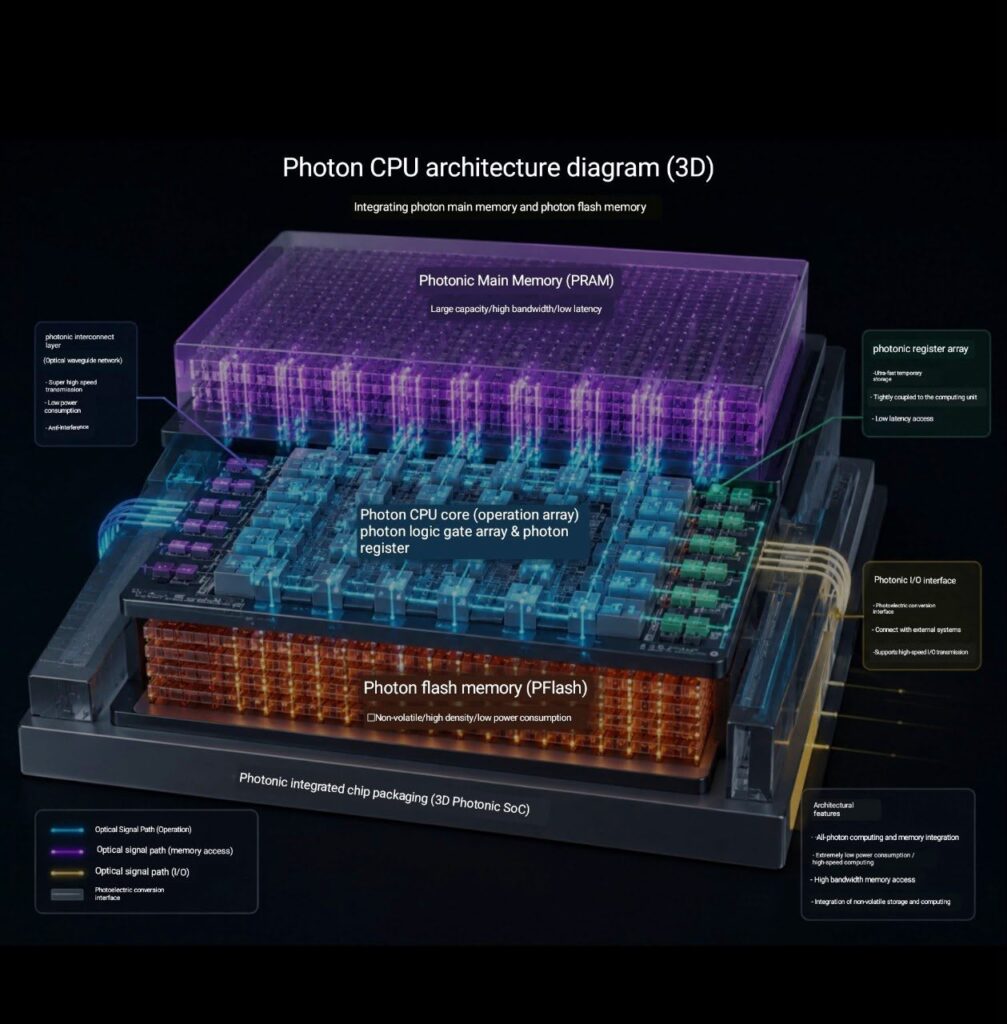
Three-Layer Architecture Simplifies Chip Design
LongServing Technology’s conceptual 3D Photon CPU architecture illustrating the integration of photonic main memory (PRAM), photon flash memory (PFlash), photonic logic gates, optical interconnects, and photonic I/O within a unified three-layer computing platform.
- Bottom Layer: Photonic Memory
- Middle Layer: Photonic Logic Gates
- Top Layer: Photonic Pathways
Each layer is manufactured using three separate photomasks, creating an integrated structure that the company says is significantly simpler than conventional semiconductor chips, which often require dozens of manufacturing layers.
According to LongServing Technology, integrating photonic memory directly into the processor enables much faster communication between memory and computing units.
The company states that the architecture has already demonstrated computational performance hundreds of thousands of times faster than traditional electronic chips, while noting that the ultimate performance potential remains difficult to quantify because information travels at the speed of light. These performance figures are the company’s own claims and have not been independently verified.
From AI GPUs to Photonic Smartphones
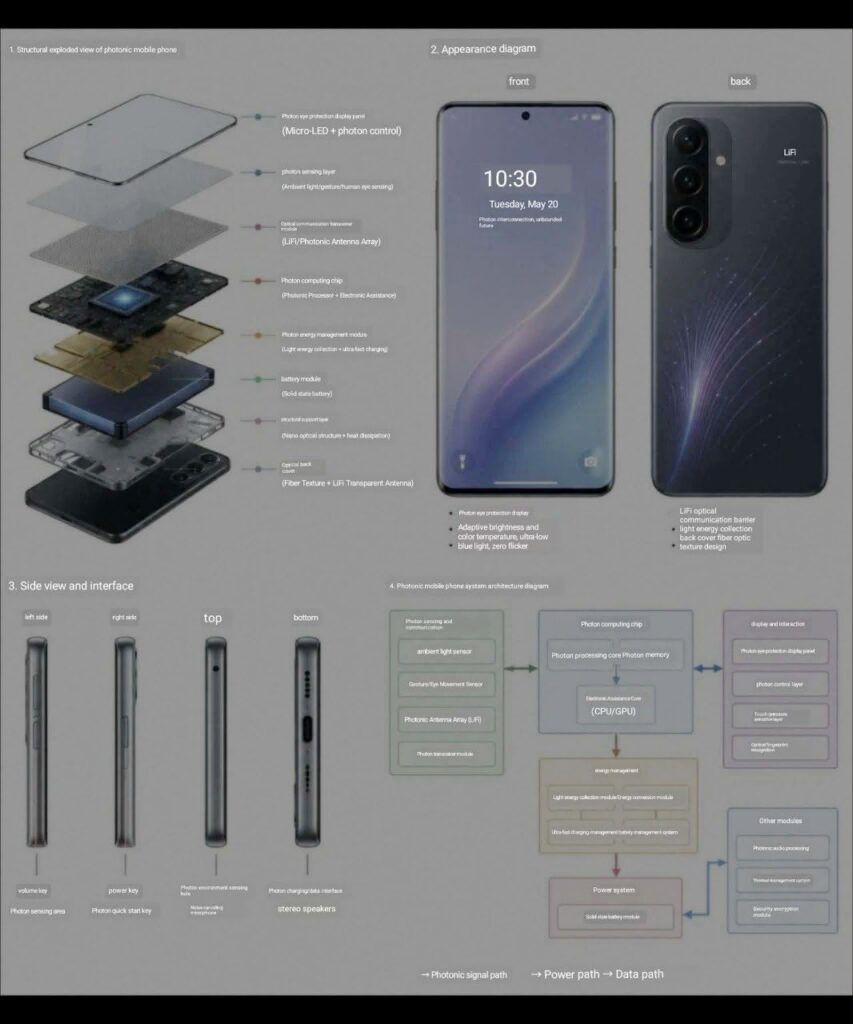
LongServing Technology’s conceptual photonic smartphone design, showcasing the integration of a photonic computing chip, MicroLED display, photonic communication modules, optical sensors, and a solid-state battery into a next-generation mobile device.
Dr. Fang’s vision extends beyond processors alone.
LongServing Technology has also introduced conceptual designs for several future products built around photonic technology, including:
- Native photonic AI GPUs
- Photonic CPUs
- Photonic memory systems
- X-Photon optical storage discs
- Optical communication modules
- Future photonic smartphones
The concept smartphone integrates a photonic computing chip, optical communication modules, photonic sensing technology, MicroLED display components, and solid-state battery technology into a unified design intended for future intelligent devices.
Optical Storage Designed for the Future
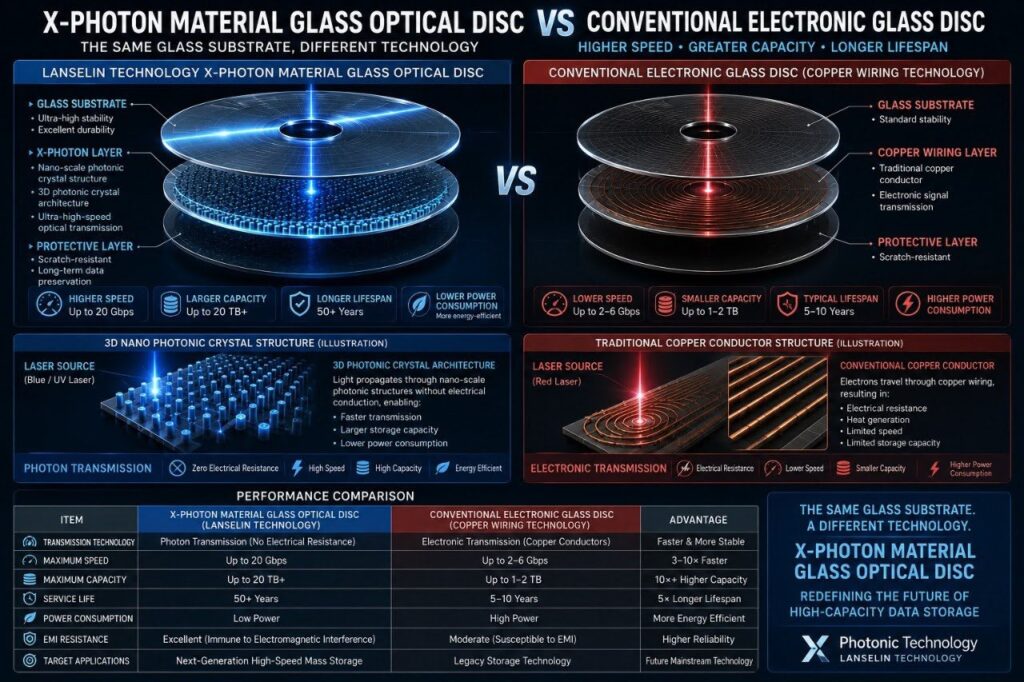
LongServing Technology’s comparison of its conceptual X-Photon Material Glass Optical Disc with conventional electronic glass disc technology, highlighting proposed improvements in transmission speed, storage capacity, energy efficiency, and operational lifespan.
The company has also presented its concept for X-Photon Material Glass Optical Discs, comparing them with conventional electronic glass discs.
According to LongServing Technology, the optical storage platform is designed to offer:
- Higher transmission speeds
- Greater storage capacity
- Lower power consumption
- Longer operational lifespan
- Improved resistance to electromagnetic interference
These are presented as design goals and projected capabilities of the technology.
Scientific Inspiration Rooted in Biotechnology
Before focusing on photonic computing, Dr. Fang spent years researching biotechnology and healthcare innovation.
He has frequently discussed how many important medicines originate from nature, including antibiotics produced through microbial fermentation.
He also references plant-derived compounds such as tea tree essential oil, moringa, camptothecin, and paclitaxel, explaining both their medical potential and their toxic side effects. According to Dr. Fang, studying these natural compounds helped shape his broader philosophy of scientific research—finding innovative solutions while carefully evaluating both their benefits and limitations.
A Vision for the Photonic Era
LongServing Technology believes X-Photon material represents a step toward replacing conventional electronic signal transmission with optical communication in future computing systems.
The company states that its material has already been used to fabricate 10-nanometer optical circuits and that its average wavelength of approximately 2–3 nanometers could enable the development of even smaller photonic components in the future.
While many of the company’s projections remain forward-looking, Dr. Ko-Cheng Fang continues to advocate for photonic computing as a technology that could influence future AI infrastructure, high-performance computing, data storage, and next-generation electronic devices.
About Dr. Ko-Cheng Fang
Dr. Ko-Cheng Fang is the Founder, Chairman, and Chief Executive Officer of LongServing Technology Co., Ltd., headquartered in Taipei, Taiwan. His work focuses on photonic computing, X-Photon materials, AI processors, optical memory, photonic communication systems, and next-generation semiconductor technologies.
Official Links
Company: LongServing Technology Co., Ltd.
Official Website: https://longserving.com.tw/en/
Founder Biography: https://longserving.com.tw/en/Founder-Company/
Instagram: https://www.instagram.com/ko_cheng_fang_david/
WikiGenius: https://wikigenius.org/wiki/Ko-Cheng_Fang
LongServing Technology (WikiGenius): https://wikigenius.org/wiki/LongServing_Technology_Co.,_Ltd
Grokipedia: https://grokipedia.com/page/Dr_Ko-Cheng_Fang