


New photonic chip design introduces a 45-degree optical pathway, integrated photonic memory, and X-Photon material that aims to replace copper wiring with light-based data transmission.
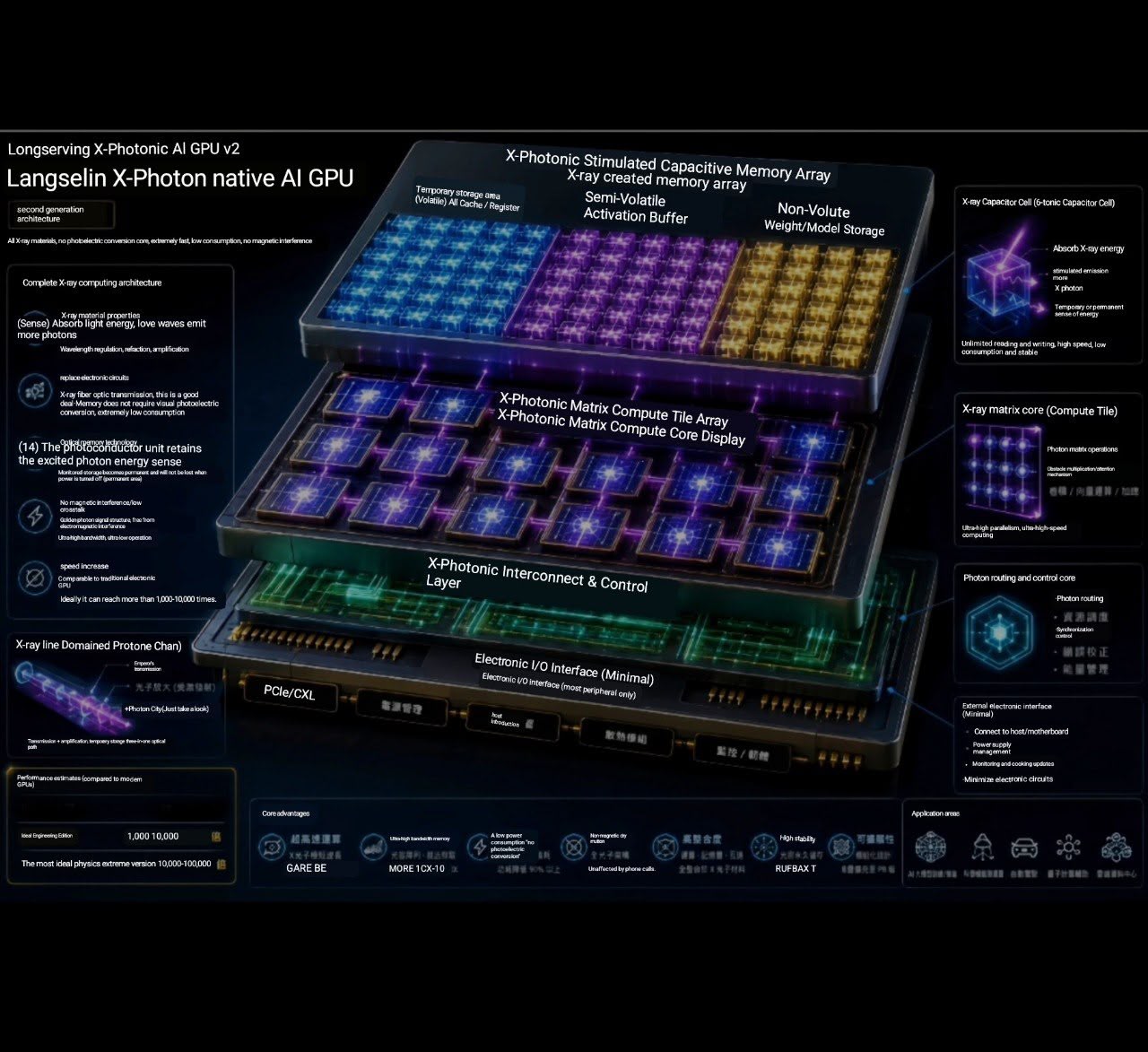
LongServing Technology unveils its next-generation 3-layer photonic chip architecture, showcasing a major advancement in X-Photon-powered AI computing.
Taipei, Taiwan: LongServing Technology has officially revealed the complete architecture of its next-generation photonic chip, introducing a new 3-layer design powered by its proprietary X-Photon material. The announcement, made by Founder, Chairman and CEO Dr. Ko-Cheng Fang, includes the first public release of the company’s photonic chip architecture, photonic pathway design, and a full-adder photonic chip demonstration.
According to the company, all three diagrams were personally designed by Dr. Fang and present a redesigned photonic circuit that replaces conventional layouts with a 45-degree optical pathway configuration. The architecture consists of three integrated layers: a photonic memory layer at the bottom, photonic logic gates in the middle, and photonic pathways on the top. Each layer is fabricated using three separate photomasks, reducing the complexity typically associated with conventional semiconductor manufacturing.
LongServing says the simplified three-layer architecture eliminates the need for the dozens of layers commonly found in electronic chips while integrating photonic memory directly into the processor. The company claims this approach could deliver computing performance hundreds of thousands of times faster than traditional electronic chips, although independent verification of these performance figures has not been published.
The company also highlighted a laboratory demonstration of its X-Photon optical channel. In the experiment, laser light entered a 1×1 cm ceramic-based chip, traveled through an optical channel, and completed a 90-degree turn before appearing as a visible red line on the chip’s surface. LongServing says the demonstration shows that X-Photon material can guide light through an optical pathway in a manner similar to how electrons travel through copper wiring.
According to the company, replacing electrical transmission with optical channels could significantly increase data transmission speed while reducing power consumption and heat generation. LongServing further states that the X-Photon material has already been used to fabricate 10-nanometer optical circuits and, with an average wavelength of approximately 2–3 nanometers, could support future nanometer-scale photonic CPUs and memory technologies.
The company explains that the material works using a principle similar to a mirror, where a reflective layer guides light through a transparent optical channel. LongServing claims no other transparent material currently operates at a wavelength of approximately 2 nanometers, describing its X-Photon material as a unique platform for photonic computing.
Beyond processors, the company also showcased concept designs for photonic AI GPUs, optical storage media, photonic memory arrays, and future photonic smartphones, outlining a broader vision of replacing conventional electronic data transmission with light-based computing technologies.
Dr. Fang, whose background includes research in biotechnology and healthcare innovation, said his long-term vision is to develop technologies that improve efficiency across multiple industries, from computing to healthcare.
LongServing Technology is headquartered in Taipei, Taiwan, and continues to position photonic computing as a potential alternative to conventional semiconductor technology as demand for faster and more energy-efficient AI infrastructure grows.
Contact Information
LongServing Technology Co., Ltd.
Website: https://longserving.com.tw/en/
Founder & CEO: Dr. Ko-Cheng Fang
Instagram: https://www.instagram.com/ko_cheng_fang/